
Essay · Pillar II — The Human Image
The Odyssey, AI, and Our Journeys
On telos, homecoming, and the difference between a life that journeys toward an end and a machine that only calculates the next answer.
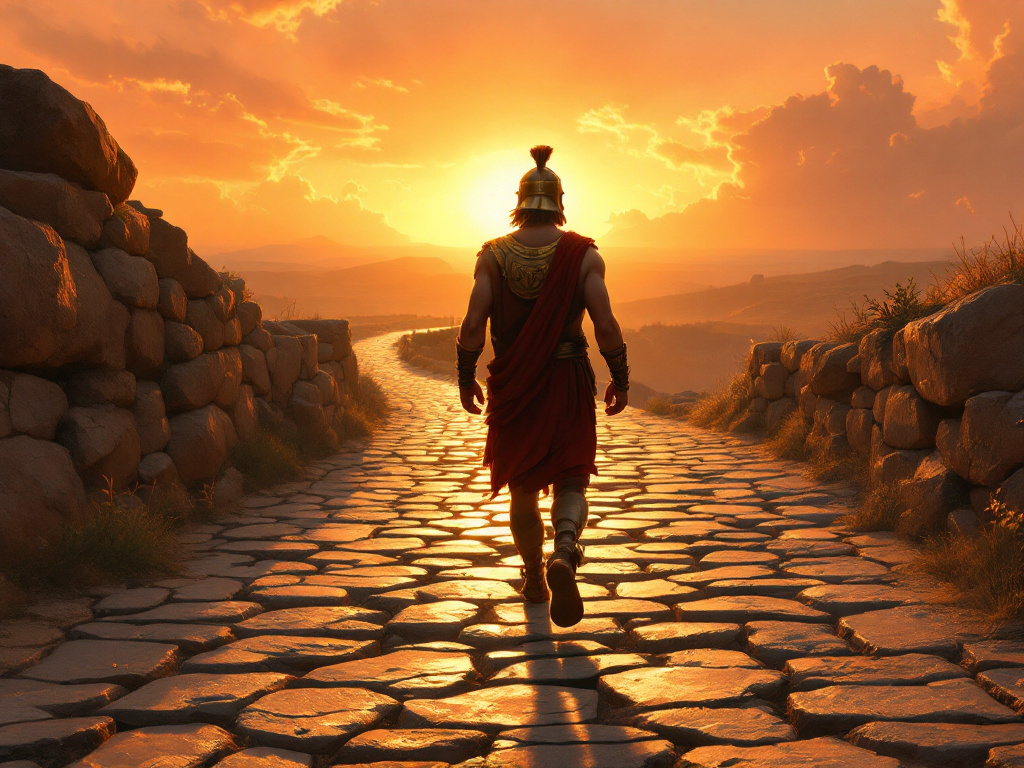
One of the contenders for this summer’s cinema blockbuster is a remake of Homer’s Odyssey. Odyssey is an extremely old story — an epic from 3,000 years ago. It is one of humanity’s earliest written explorations of what it means to live a heroic, purposeful life. Many of us would like to live our lives with purpose, and perhaps a touch of heroism. While civilisation undoubtedly is older than the Greeks, works like The Odyssey offer some of the oldest surviving insights into the human condition.
The Odyssey follows Odysseus as he strives to return home to Ithaca after the Trojan War. His journey is a relentless pursuit of his telos — the Greek word for ‘end’ or ‘goal’ (τέλος), meaning ‘to set out for a definite point’. Odysseus’ telos is reunion with his family, but his path is fraught with trials that test him. The story is about his journey and all the challenges, ups and downs along the way.
Our lives, like Odysseus’, are spent in pursuit of a telos. We journey through stages — childhood, adolescence, professional life, retirement, old age. Along the way, we chase smaller goals: passing exams, finding a job, building a family, buying a home. These milestones are not the outcome in themselves, even if we can think they are at the time; they are signposts on the road toward our ultimate end.
We tend to ignore the latter stages of the telos, especially when we’re young. And yet we all reach the telos at some point, and many of the important decisions we make in life should be guided by an awareness of that ultimate end. Where do we go when the journey ends? The decisions we make today — how we love, how we work, how we treat others — should be guided by an awareness of that final point. What does it mean to arrive?
AI and the Absence of Telos
Artificial intelligence, for all its sophistication, does not understand telos in the way we do. It has no destination, no ultimate purpose. An AI does not strive; it calculates. Its existence is not a marathon but a series of very short sprints — each query is a new race, each response is just a finish line that becomes the starting line for the next race.
For an AI, the journey is a very short one: to solve the puzzle posed by the person on the other side of the screen. It is like a child running round and round in a circle, growing dizzy, exhausted, and giddy, but never moving forward. There is no arrival, no moment of true fulfilment. The next question is always waiting, the next problem always unsolved.
This is not to dismiss the value of AI. It can simulate intelligence, even creativity. It can make our lives more meaningful and efficient. But it cannot understand that our lives are heading toward a final destination, whether in the short term or the long term. It cannot grasp the weight of a life lived with purpose, or the tragedy of a life lived without one. It could not have made sense of Odysseus’ journey. If asked, it might have said, ‘Now the war is finished, just stay here in Troy. It’s peaceful, by the sea, and you know people here.’ But that would miss the point entirely: Odysseus’ telos was not comfort or convenience. It was to go home.
The Telos of All Things
In the Book of Revelation, the telos of all creation is described as a reunion with the Creator — a closing of the circle that began at the dawn of existence. It is the final step on the journey of life, the moment when all things are made new, when separation gives way to unity. The circle of life is closed, and our journeys are complete.
This vision of telos is not just about the end of an individual life, but the end of all things. It is the promise that every journey, no matter how long or winding, finds its resolution in the arms of the One who first set things in motion. In this light, even the trials of Odysseus take on new meaning. His struggles are not just obstacles to be overcome but steps toward a greater wholeness. To be made in the Imago Dei is to be made for that homecoming — to carry, however faintly, the memory of where we came from, where we are going and where we will end up.
A Question for the Age of AI
So how do we explain this to an AI? At the end of time, it may still be spinning, endlessly refining answers it cannot comprehend. It will never know the relief of arrival or the joy of homecoming.
But we do. Our journeys are not about solving puzzles — they are about becoming who we are meant to be. They are about love, loss, longing, and the hope of seeing the face of God. That is the telos that gives every step its meaning.
And perhaps that is the most human thing of all.
Go deeper
Explore more essays on the human image.
The Why asks what we would actually want to know if intelligence itself became abundant.
Browse all essays