
Essay · Pillar I — The Divine Image
The Image and the Algorithm
What does it mean to be made in the image of God in an age of generative machines?
Two kinds of image
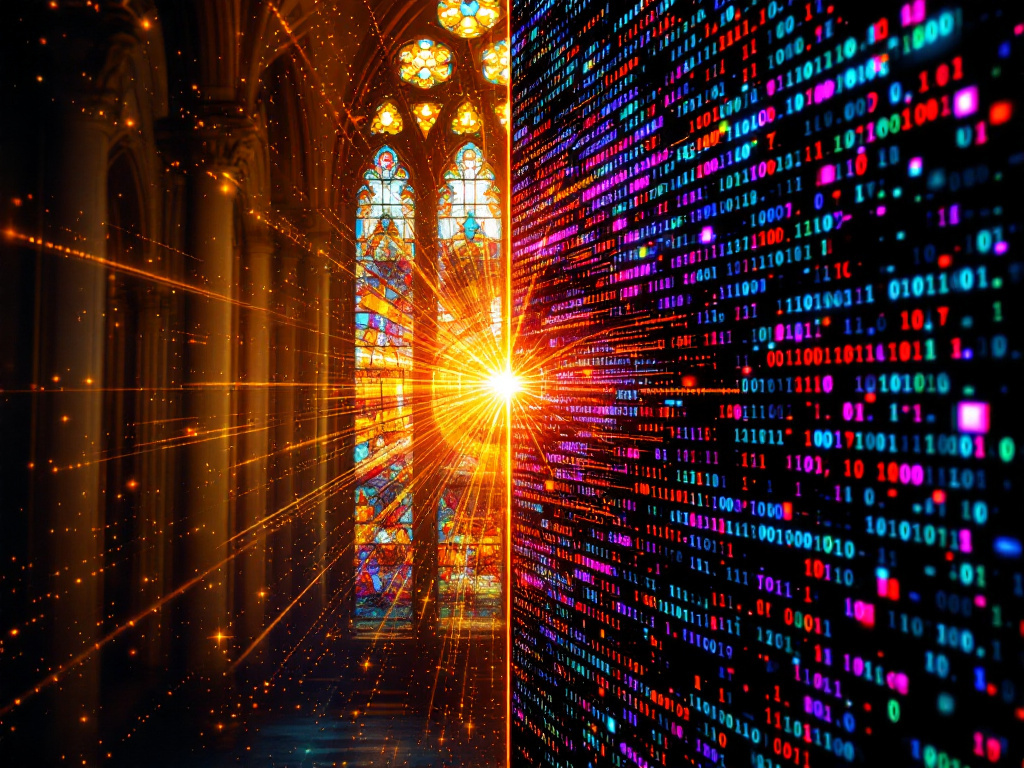
An LLM (Large Language Model) produces images of you. Trained on the accumulated weight of human writing, it proposes sentences to you that sound just like you want to sound, or advice that resembles yours when you're having one of those rare super-smart days. But it is, to be very precise, an image-making machine, a photocopier on steroids.
The Biblical tradition speaks of another kind of image. To be human - the author of Genesis writes - is to be made in the image of God, Imago Dei in Latin. Not as a mirror of data and statistics, but a likeness given from above: relational, moral, irreducible to function. Two images, then. One which is generated invisibly as we click; the other bestowed on us at birth by the Creator.
What the algorithm sees
An algorithm sees patterns. It does not see the person. It cannot tell whether the sentence it just produced is true, wise, or kind. It can calculate only that this sentence is the highest probability one to give as its answer. This is not a failing of the engineers who designed it; it is the very nature of the tool. A model optimises; it does not discern.
The danger is not that the machine will become like us. The danger is that, in spending our days with it, we will quietly come to think of ourselves as the machine thinks of us: as a pattern to be completed, as a behaviour to be predicted, as an output to be optimised. And in doing so, we will lose the very essence of what it means to be truly alive.
Think about the last time you felt truly alive - whether through excitement, fear, awe, love, or any one of those other emotions. Could an algorithm even truly that?
What the Imago protects
Imago Dei is a refusal. It refuses to allow the person to be defined by what she produces, by how legible she is to a system, by the value the market can extract from her. The infant who cannot yet speak, the elderly person who has forgotten her own name, the stranger whose work we will never need — each is already created in Imago Dei.
This is the conviction the algorithm cannot give us, and the one we will most need in the years ahead. The Imago Dei is not earned. It is not optimised. It is given, it is shared, and it is what makes us a human being, not just a data point.
Living between the two
We will use these tools. We should. We must, for the good of all humanity. They are truly remarkable, and much of what they can do has the capacity to be genuinely good.
The question is whether we can use them while keeping intact the true image — the one that says a person is more than the sum of what she can be made to produce.
That is not a technical problem. It is a spiritual one. An existential one.
And it is the work this project exists to do. If you agree, please share this post, comment below, or sign up for The Letter on our website.
Continue the conversation
What’s your take?
Leave a reply below, subscribe to The Letter, or send a note directly. We’re gathering thoughtful responses from readers, pastors, scholars, and technologists.
If you enjoyed this, you might also like
Theology of Artificial Intelligence
A clear foundation for thinking theologically about AI, the soul, work, knowledge, and the dignity of the made person.
6 min readThe Selfie and the Soul
A reflection on identity, performance, and the soul in an age where the self is endlessly photographed and optimised.
Replies
Leave your reflection
Loading replies…